
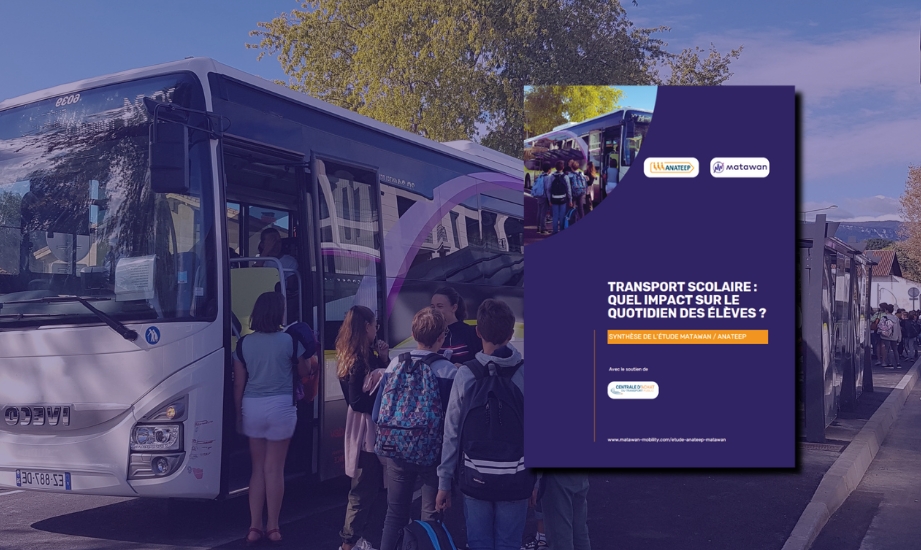
School transport is a cornerstone of regional cohesion. However, the day-to-day reality for students – including commute times and daily spans – has remained largely undocumented until now. To shed light on this “pedagogical cost,” Matawan and ANATEEP (the French National Association for Educational Transport in Public Education) are releasing the results of a statistical analysis of unprecedented scale.
For a long time, the management of school routes was approached almost exclusively from logistical or budgetary perspectives. The aim of this partnership between Matawan and ANATEEP is to reflect the actual daily experiences of french students, backed by exceptionally broad statistics:
17,504 school services analyzed
5.5 million trips studied
717,000 students tracked daily, from kindergarten to high school
Representing 47% of the total student population transported across the observed regions of France
This large-scale processing was made possible by mobility data from Matawan and participating local authorities. The algorithms of WanData, Matawan’s Data Intelligence platform, enabled the reconstruction of complete student journeys (origin to destination). Consequently, indicators that are notoriously difficult to measure could be analyzed:
Daily Span Analysis: Using advanced algorithms, the study breaks down the time spent away from home—from the first morning departure to the final evening return—to assess the actual impact of commuting on students’ daily rhythms.
Structural Territorial Comparison: By cross-referencing flows between urban (AOM) and regional areas, the analysis examines the efficiency of territorial networks and the true influence of urban density on travel times.
The Influence of Geographical Factors: The methodology isolates parameters such as terrain to determine whether topography is a primary cause of longer commutes or if administrative organization takes precedence over physical geography.
Seasonal Behavior Observation: Automated Big Data processing reveals shifts in usage throughout the school year, notably “disaffection” (drop-off in use) or the use of transit passes outside of standard home-to-school commutes.
By leveraging millions of anonymized data points, this “X-ray” of school transport provides public decision-makers with a compass to understand real-world usage and optimize quality of service.
